September 16, 2025
The volume of legacy data within the oil and gas industry is vast and increases at a rapid pace every day. This data must be integrated and interpreted with consistency to understand the subsurface better and reduce uncertainty for high-quality, high-velocity decision-making.
A critical obstacle for exploration and production companies is not just to find the data, but to find tools and techniques to analyze, interpret, and understand the subsurface. In addition, manual petrophysical interpretation of lithology from wireline data is a tedious process. Given the volume of data and limited in-house resources, traditional approaches cannot incorporate everything available. How can you close the gaps in your interpretation and reduce subsurface uncertainty?
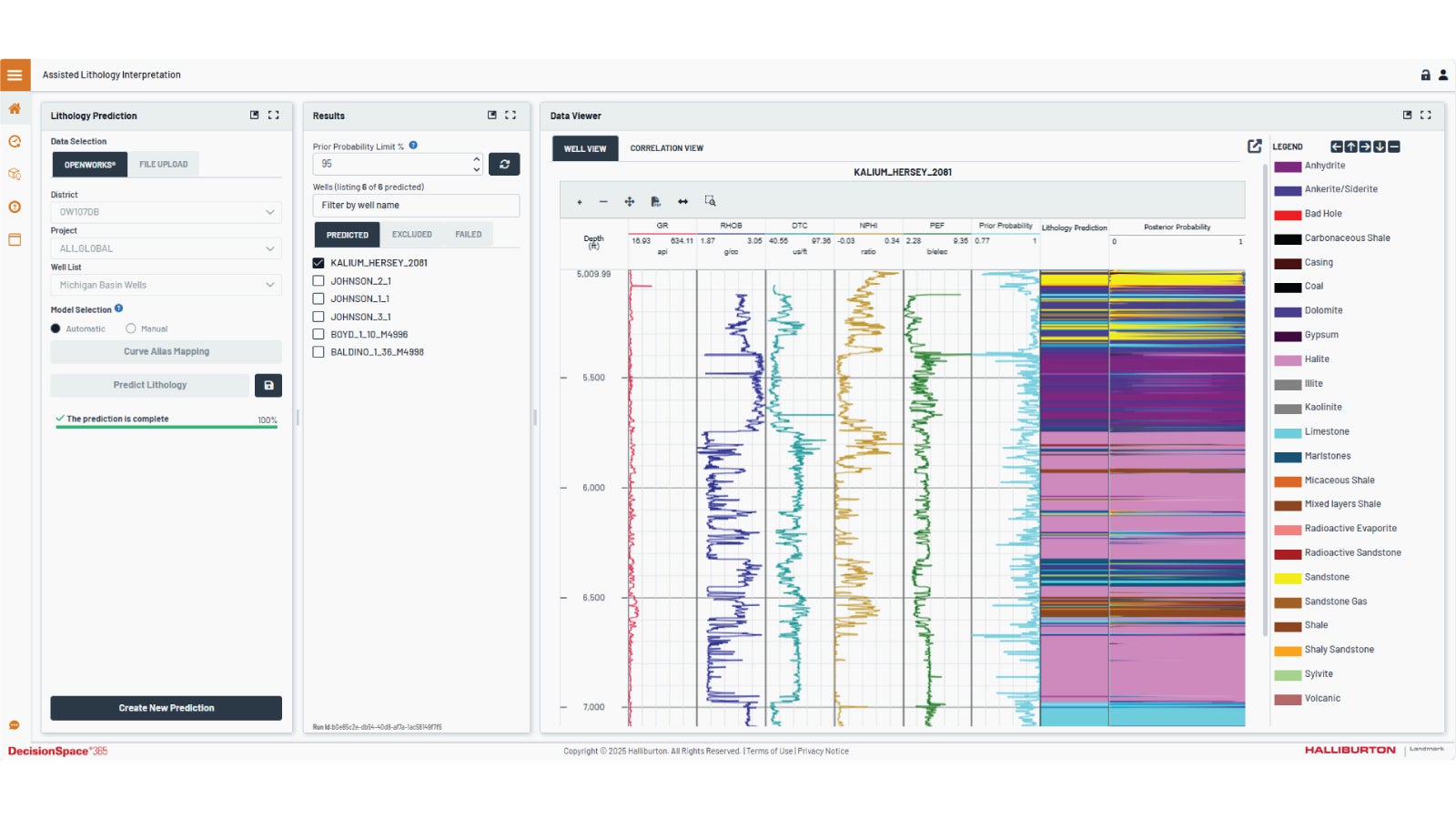
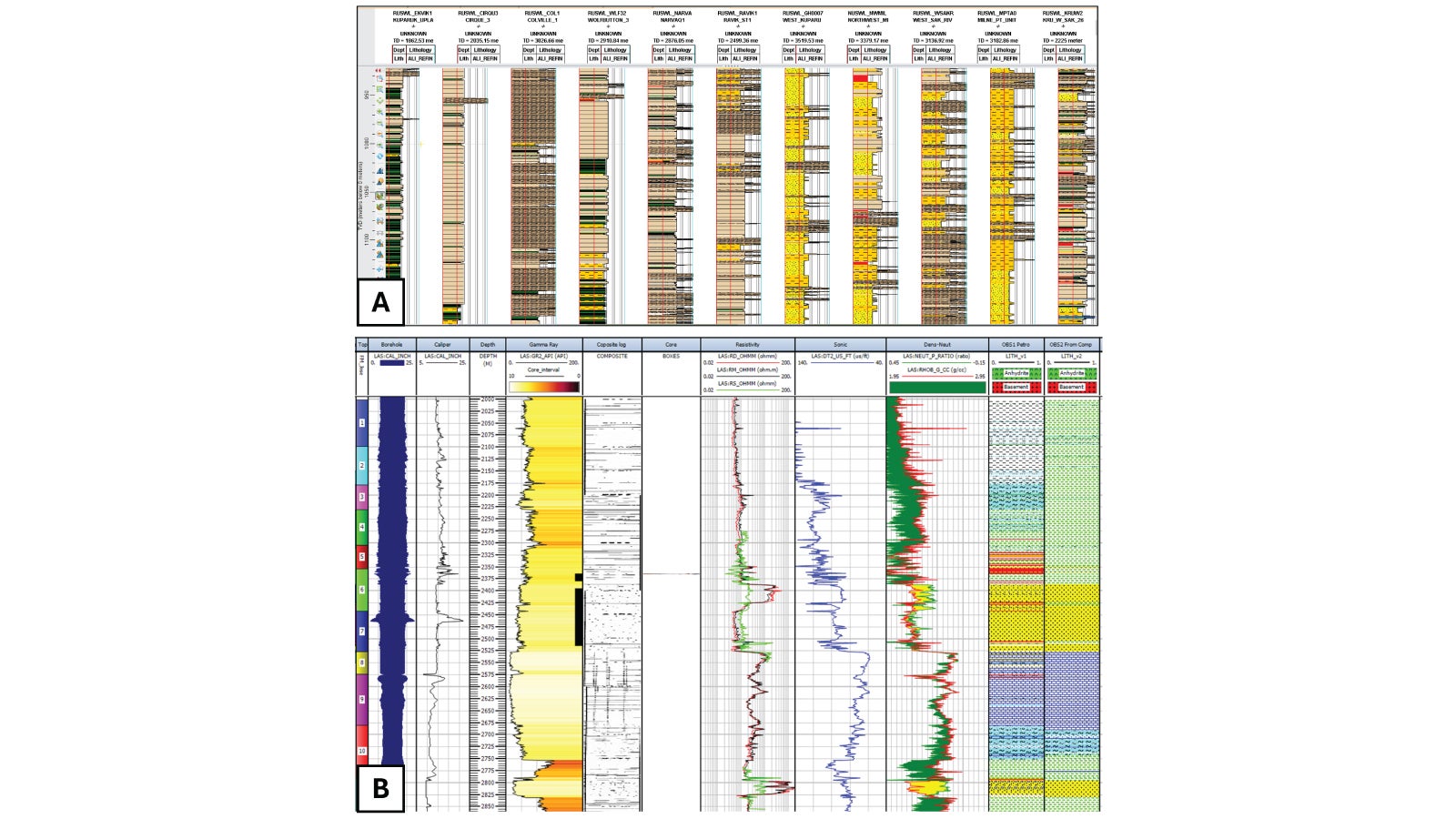
You can address these issues with DecisionSpace® 365 Assisted Lithology Interpretation (Figure 1). It allows the user to interpret and extract value from new and legacy well data and create consistent, high-quality subsurface models. Assisted Lithology Interpretation delivers contextual and integrated interpretation using artificial intelligence (AI) through a supervised machine learning (ML) technique to predict lithology from wireline log responses based on trained models. This helps support rapid and consistent lithology interpretation and faster decision-making cycles.
Assisted Lithology Interpretation also offers well-to-well lithology correlation that can improve understanding of surface geology and reservoir characterization.
Deliver rapid and consistent lithology interpretations using trained lithological models provided by default within Assisted Lithology Interpretation. These models have been built through close collaboration between data scientists, geoscientists, and petrophysicists.
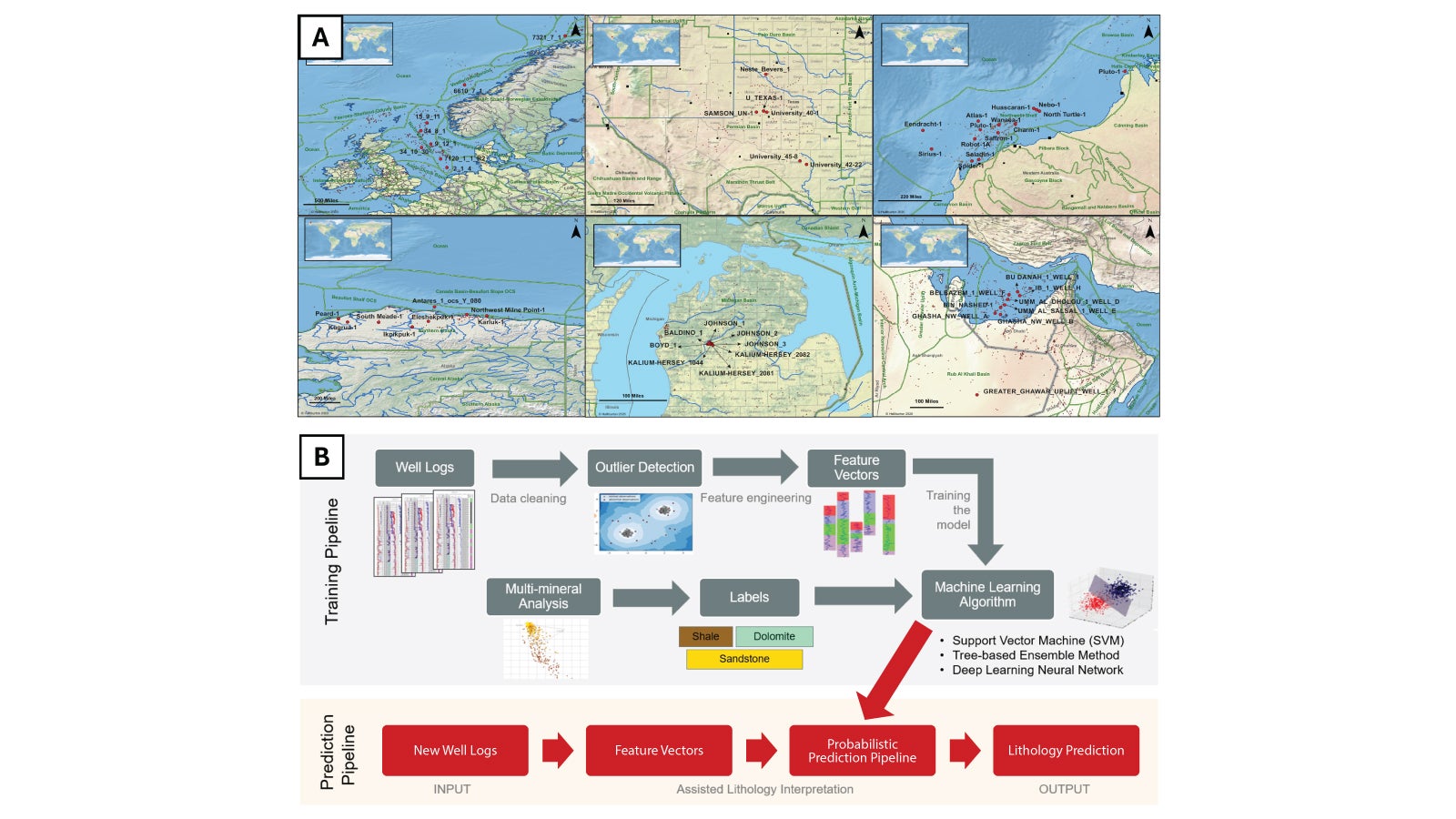
The models have been trained using supervised ML techniques (Figure 2) that incorporate wireline and logging-while-drilling (LWD) data. Algorithms are encoded with intelligence to recognize combined features in well log curves and quantitatively assess the likelihood that these represent a particular lithology, based on previous examples seen by the system.
The F1-score, a statistical measurement of model performance, was used, alongside other metrics, to assess the accuracy of the predictive models generated.
Assisted Lithology Interpretation (Figure 2a) can deliver rapid and consistent lithology interpretations with trained models. These models have been built through close-knit collaboration between data scientists, geoscientists, and petrophysicists.
They are trained using supervised ML techniques (Figure 2b) that incorporate wireline and logging-while-drilling (LWD) data. Algorithms are encoded with intelligence to recognize combined features in well log curves and assess the likelihood that these represent a particular lithology. The F1-score and other metrics are used to assess the accuracy of the predictive models generated.
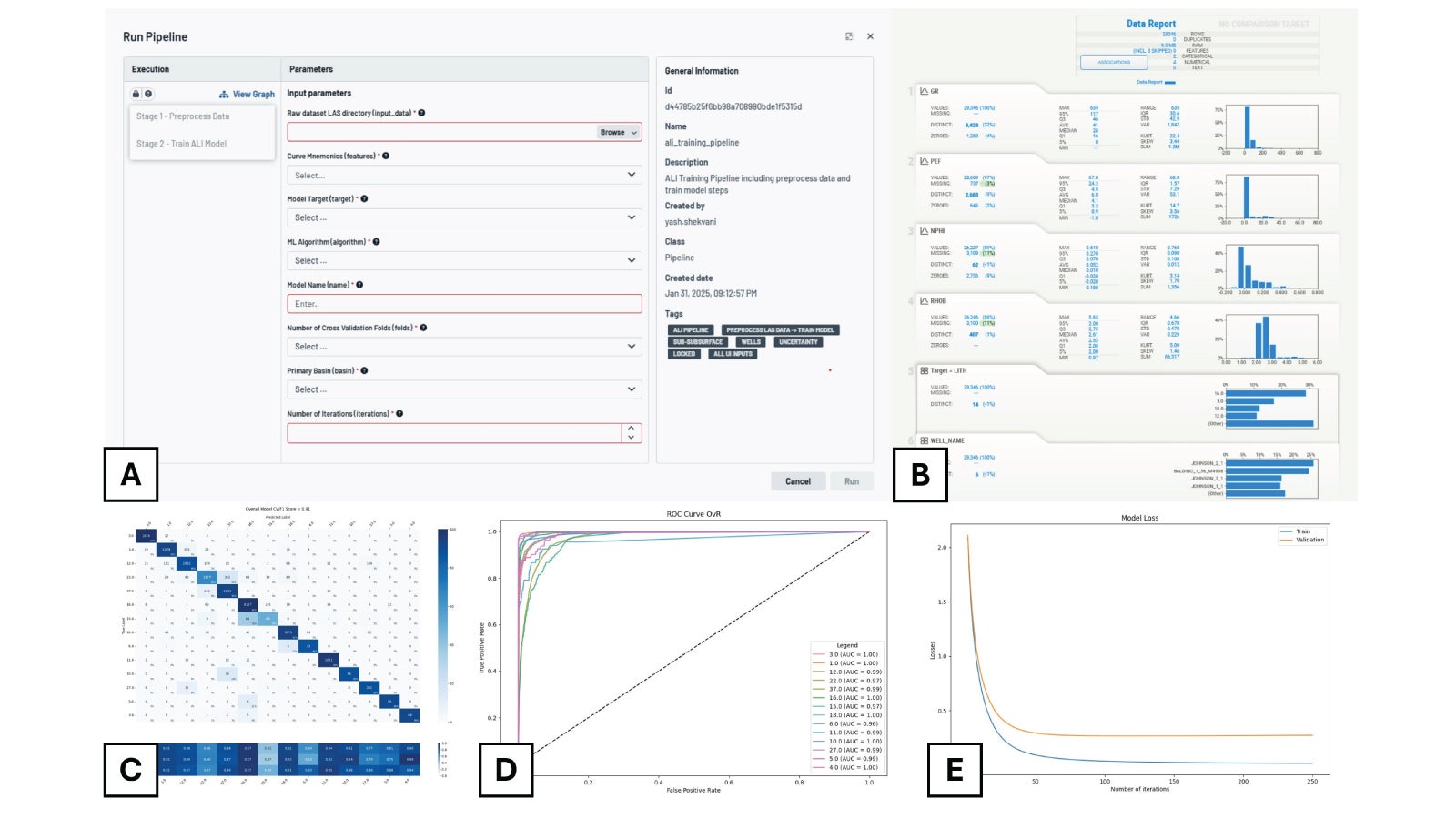
Custom models trained by proprietary data and interpretations can also be used within Assisted Lithology Interpretation. Custom models can be trained for each individual. Alternatively, geoscientists, petrophysicists, or data scientists can use an integrated model training workflow within DS365.ai suite (Figure 3), a cloud-native, open architecture platform with ML operations capabilities, to train models with ease.
When the same model is applied to a dataset, it can better constrain reservoir and seal lithofacies. It also helps identify potential bypassed pay. All of this can be achieved in just minutes, in hundreds, if not thousands, of wells, and can empower the user to extract more value from the data in a fraction of the time and at a fraction of the cost.
Trained algorithms facilitate standardized processes and help reduce interpreter bias. This delivers consistent data interpretation in an enterprise. The system connects with and saves lithological data as computed lithology against the well. This allows workflows to proceed without the requirement to import or export. It also allows the user to track and access previous runs, which can be used to monitor historical work and retrieve stored output.
Users can connect with and collaborate with peers with immediate shared access to consistent lithology characteristics for thousands of wells and the most current subsurface comprehension.
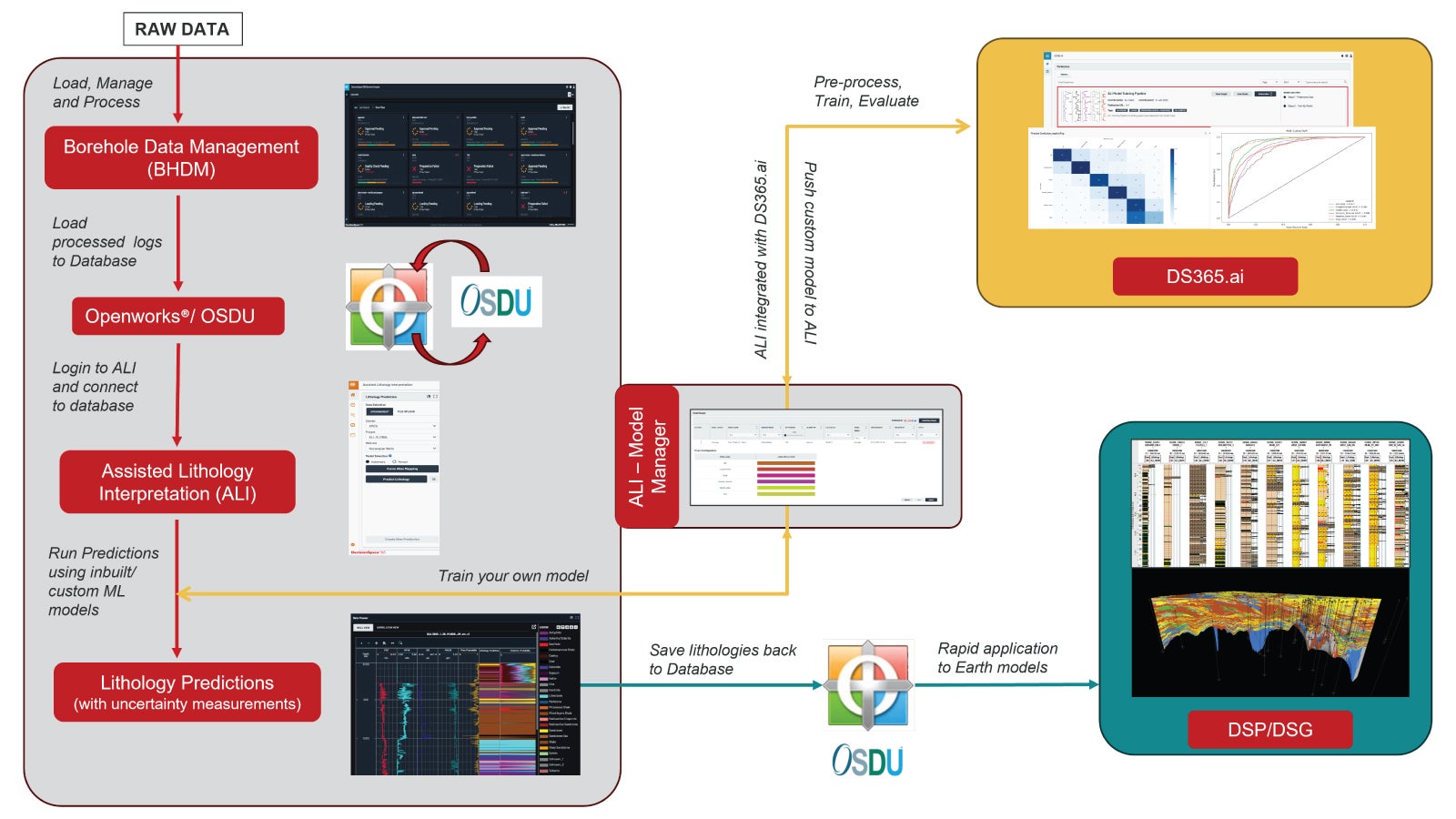
Open architecture allows users to connect and integrate with Data Foundation, the DecisionSpace® 365 data platform, read/write from the OpenWorks® database, Open Subsurface Data Universe (OSDU™), the cloud-native data platform that allows seamless access, sharing, and integration of data in various applications and workflows, and other industry-standard databases, as well as user data lakes, to provide unparalleled choice and flexibility (Figure 4).
The use of algorithm interpretation also means users can conduct multi-scenario analysis on the same datasets to aid lithology prediction and reduce subsurface uncertainty (Figures 5a and 5b). The outcome is an accelerated decision-making cycle.
Built-in confidence measures apply quantifiable confidence limits to data. The uncertainty of lithology predictions is captured and tracked throughout the interpretation workflow on a well-by-well basis. This allows for the calculation of confidence at any point in terms of a percentage.
These calculations include prior and posterior probability measures, which allow users to analyze the confidence outputs and make more informed recommendations that lead to smarter investments.
Unlike conventional approaches, a supervised ML pipeline that predicts lithology from wireline or LWD data, based on trained lithological models, provides consistent interpretation from surface to total depth. Users can access a high-resolution view of reservoir and seal lithofacies, overburden characterizations, and potential bypassed pay in just minutes, throughout hundreds, if not thousands of wells (Figure 4).
Assisted Lithology Interpretation’s consistent, rapid, and high-fidelity lithological predictions, plus quantitative uncertainty, means an organization’s human expertise can be applied where it is most critical: to make decisions.

Dr. Tim Ferriday
Solution Owner, Well Analysis

Shweta Mondal
Product Owner, Assisted Well Interpretation
Emily Collett
Geoscience Advisor and IP Manager