October 6, 2025
The Mesozoic and Cenozoic petroleum systems of the Middle East supply large volumes of hydrocarbons to meet global oil and gas demands. Exploration and production have primarily targeted shallower Mesozoic and Cenozoic systems. These systems host many of the giant and supergiant hydrocarbon fields along the eastern backbone of the Arabian Peninsula. The Paleozoic continues to contribute substantial volumes. Gas reserves in the Permo-Triassic Khuff carbonates are charged from the Silurian Qusaiba Formation, a prolific unit in Arabia.
Researchers must assess, understand, and analyze large volumes of multidisciplinary data to determine the distribution of petroleum system elements. However, valuable public domain data in the Middle East becomes scarce after the Permian period. In the Precambrian-Cambrian, data availability further shrinks to isolated pockets, and the limited subsurface penetration into Paleozoic stratigraphy adds uncertainty. At greater depths and ages, key petroleum system elements remain poorly defined.
This article summarizes the hydrocarbon potential of underexplored Paleozoic intervals in the Middle East using a plate-wide screening approach. This approach can help identify exploration zones with multiple stacked play opportunities. Data and insights from the Neftex® solution by Halliburton Landmark offer a valuable first-pass contribution to help locate potential exploration zones. Further details are available in Gravestock et al. (2025), with supporting content in the Subsurface Insights article and webinar series by Halliburton Landmark.
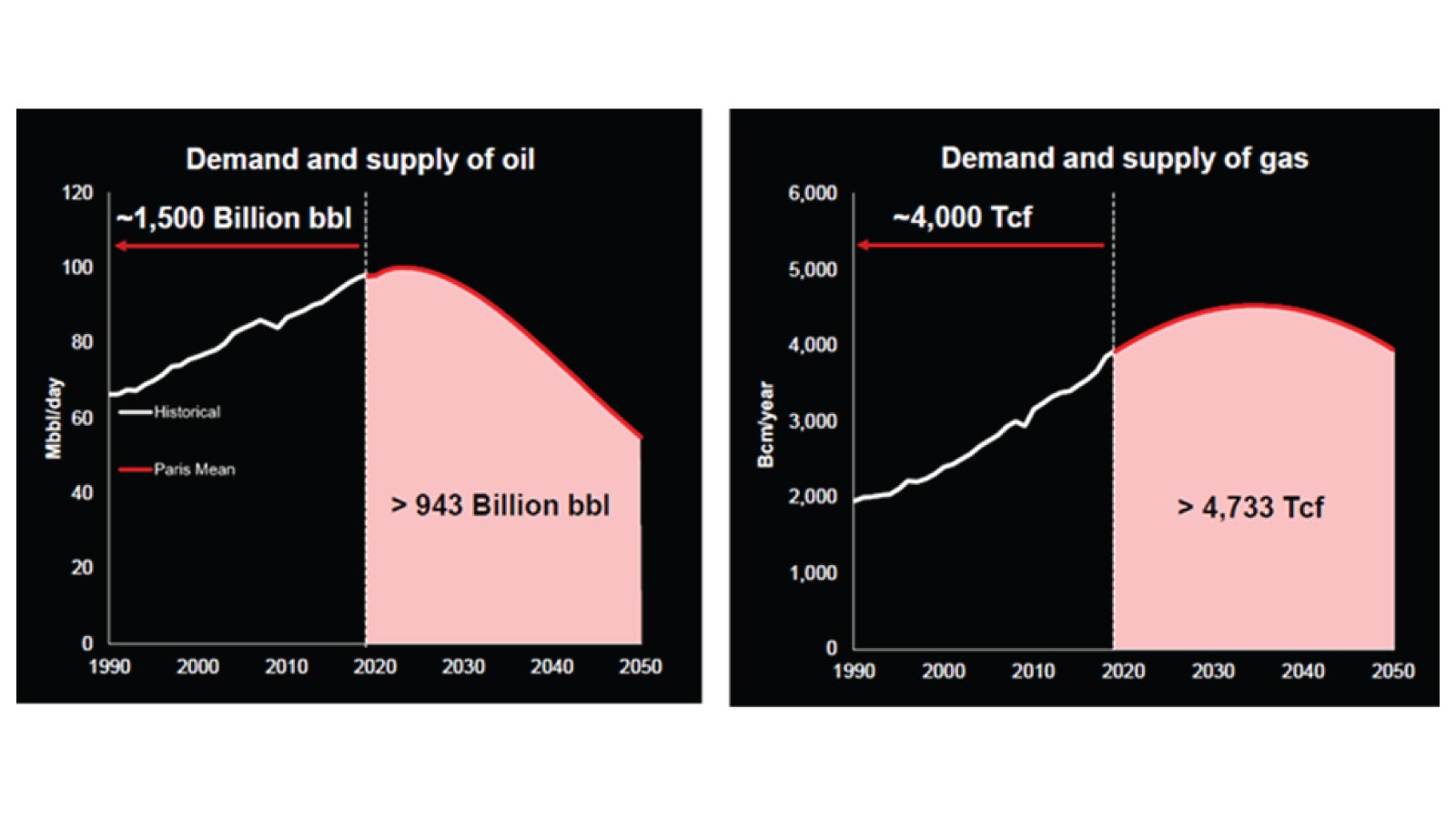
Through 2050 and beyond, global energy demand will continue to include oil and a substantial volume of gas. Current gas assets will be insufficient to meet forecasted demand (see Figure 1). Exploration is needed to identify new subsurface gas reserves. This supply gap positions the Middle East as a key contributor to future gas production. Much of this future supply may reside within the Paleozoic stratigraphy.
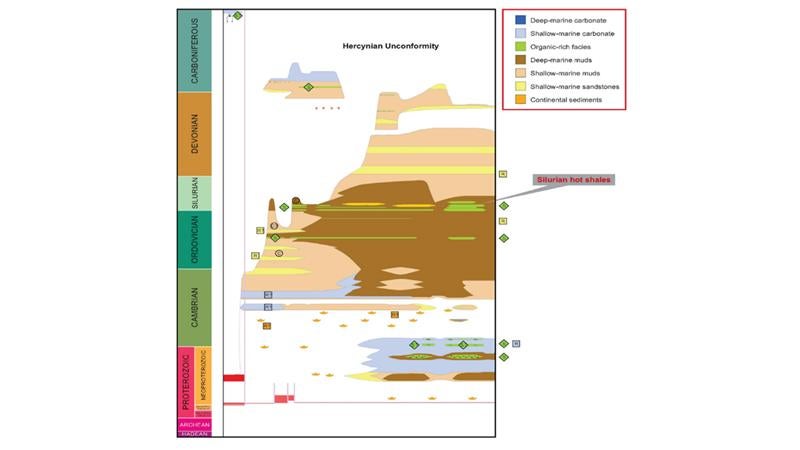
Middle East Paleozoic stratigraphy remains largely underexplored, excluding Precambrian and early Cambrian intervals that contain petroleum-bearing carbonates, particularly in Oman. Siliciclastics dominate much of the stratigraphic succession (see Figure 2; Sutcliffe, 2016).
In the Arabian Plate, gas primarily originates from organic-rich shales of the early Silurian Qusaiba Formation and its equivalents. Its distribution in the Arabian Peninsula is influenced by preservation beneath the Late Paleozoic Hercynian unconformity, major structural depressions, and paleobathymetric variations from the Late Ordovician (Hirnantian) glaciation.
Its subsurface position enables hydrocarbon charge into both younger and older Paleozoic stratigraphy (Sutcliffe and Cousins, 2018). At present-day depths, much of the Silurian is overmature. Accurate charge timing and migration pathway analysis—lateral, vertical, or involving multiple mobile phases—is essential to assess structural development.
Gravestock et al. (2025) identified six key fairways that span the Paleozoic to earliest Mesozoic, which include: Middle-Late Ordovician Qasim Formation, Latest Ordovician (Hirnantian) Sarah Formation, Early-Middle Devonian Jauf Formation, Permo-Carboniferous Unayzah Formation, Permo-Triassic Khuff Formation, and Middle-Late Triassic Jilh Formation.
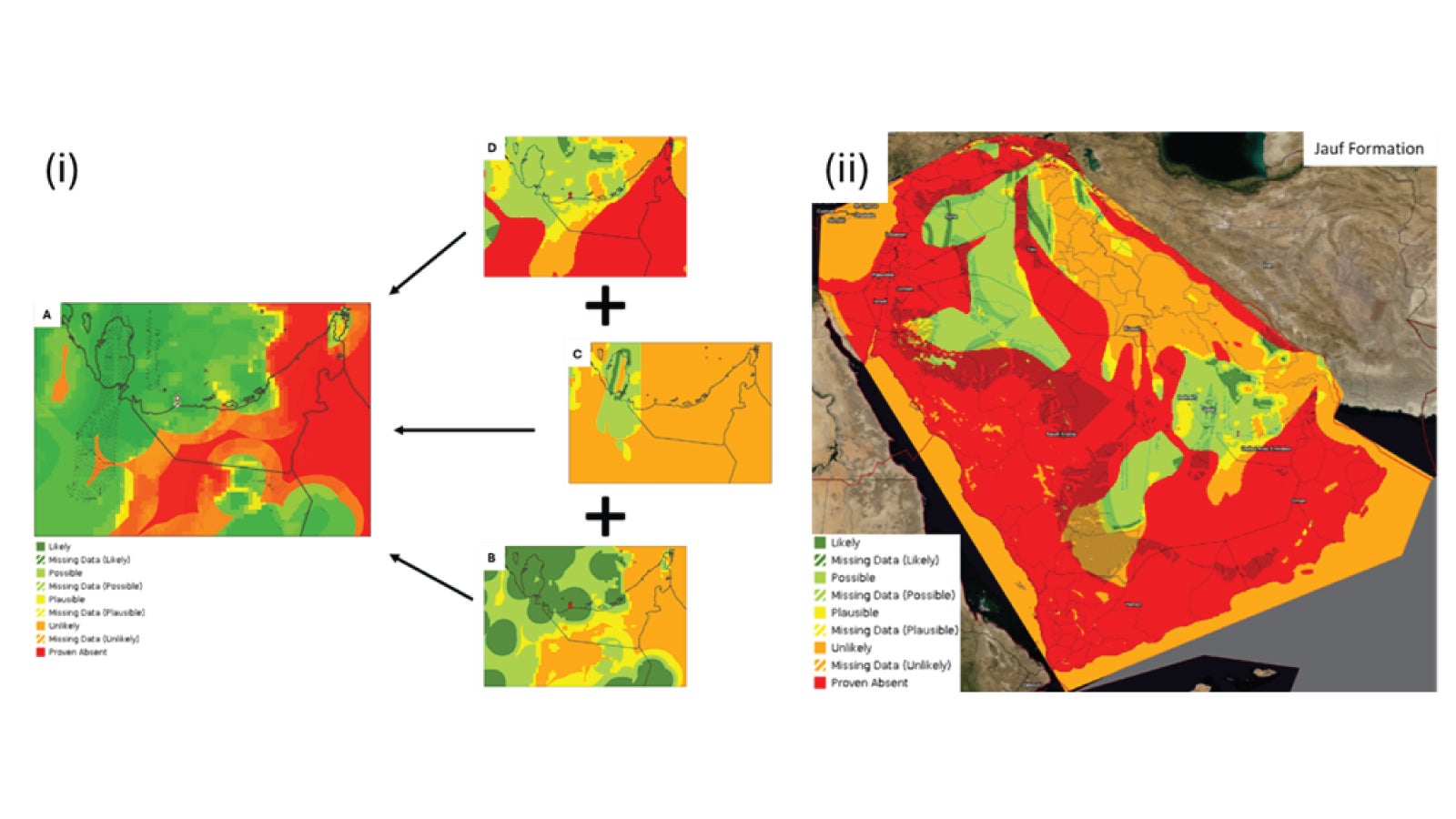
A plate-wide screening methodology was applied, carrying forward the highest petroleum system element risk into the final Combined Common Chance Map (CCCM). This approach illuminates zones in Arabia where an individual play has the maximum potential. Input parameters, such as source rock presence or the nature of individual reservoirs, were derived from the integration of multidisciplinary subsurface datasets. These datasets are all tied to a stratigraphic framework within the Neftex solution.
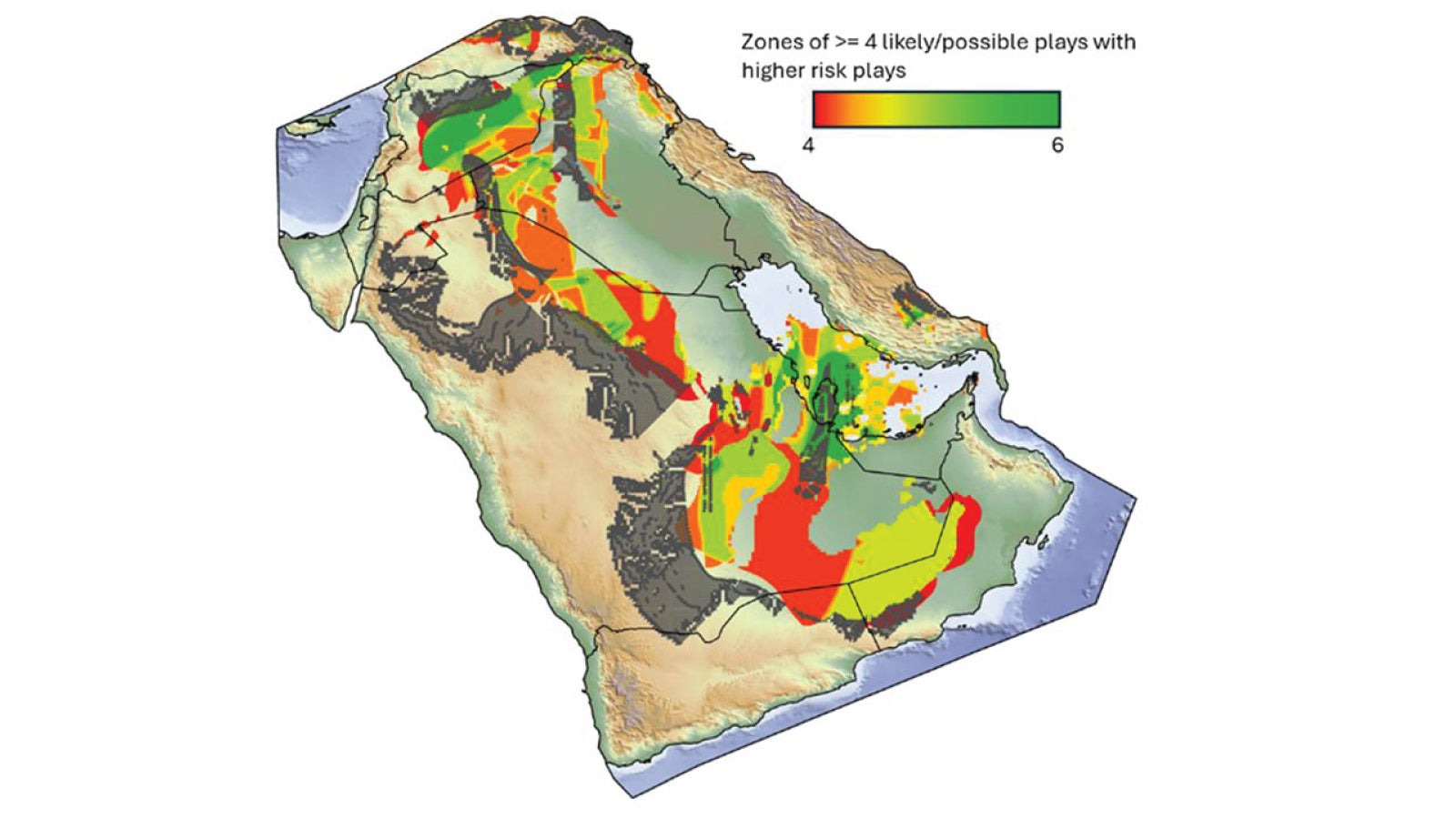
Each identified play fairway was assessed individually with a focus on charge from the Silurian Qusaiba Formation and its equivalents. An arbitrary migration distance of 80 km from the source kitchen was applied (Gravestock et al., 2025). Results from individual play fairway analyses were stacked to generate final outputs that highlight areas of stacked play potential (Figures 3 and 4).
Review of the final CCCM for each fairway reveals zones of potential in the Arabian Plate (Figures 3 and 4).
These zones are investigated using proprietary datasets to identify exploration potential, manage risks, and build a portfolio of opportunities. While zones of maximum potential have been identified in each fairway, this first-pass, plate-wide screening approach focuses on charge from the Silurian Qusaiba Formation and its equivalents.
Beyond the Silurian, multiple source rock horizons may contribute to deep gas plays (Figure 2). For example, equivalents to the Huqf Supergroup source rocks, proven in Oman, may be preserved elsewhere in Arabia.
Understanding deep gas systems within the Middle East benefits from a regional approach that contextualizes the distribution of petroleum system elements and processes. A play screening workflow helps assess the presence and effectiveness of each petroleum system element and identifies key risks for each area that influence development.
The workflow identifies multiple zones in the Arabian Plate where deep gas plays may be viable, provided a sufficient trapping mechanism is present. Stacking individual fairways (Figure 4) reveals high-grade areas in the Arabian Peninsula that may have multiple stacked play opportunities. Proprietary datasets can be used to test and validate these zones.
Stacked play potential is observed near basin highs (e.g., the Qatar Arch) and rifted basin margins (e.g., the Palmyrides) as shown in Figure 4.
Limited stacked play potential in some areas of the Arabian Plate results from erosion associated with the Hercynian unconformity and stratigraphic removal or non-deposition. Reservoir effectiveness and charge risk due to burial depth also contribute (Figure 4). The Paleozoic stratigraphy of the Middle East shows plate-wide potential and may replicate exploration and production success seen in the Mesozoic and Cenozoic.