Mature Fields

Reduce overall time and costs required to deliver horizontal wells
Middle East

Reduce overall time and costs required to deliver horizontal wells. Improve ability to image detailed geologic features such as thin beds, fractures and dipping planes while drilling.
Sperry Drilling Services field-tested the AFR™ (Azimuthal Focused Resistivity) sensor, one of Sperry’s next-generation Logging-While-Drilling (LWD) sensors, which produces high-resolution structural and stratigraphic images of the borehole.
By eliminating unnecessary runs, use of the InSite AFR sensor in three horizontal wells saved about nine days of rig time worth approximately $450,000. The sensor also clearly revealed numerous geologic features.
In 2007, the onshore operations arm of a national oil company in the Middle East decided to field-test the InSite AFR sensor. To date, the sensor has been successfully deployed in at least four horizontal wells.
“Classical resistivity images taken by running electrical wireline tools with ‘pipe-conveyed,’ or TLC, techniques require a separate logging run after drilling the complete horizontal section,” explained one of the company’s Senior Operations Engineers. “With conventional wireline logging on TLC, another special trip is needed to spot enzymes after pulling out the logging tools. Moreover, the probability of a stuck tool increases while logging through TLC.” Since multiple runs are necessary, it takes an average of three extra days after drilling the borehole to run conventional wireline imaging logs in this particular reservoir. Therefore, the operator has been keen to use LWD sensors to minimize total rig time and reduce the overall cost of operations.
What’s more, as the Senior Operations Engineer observed, the quality of resistivity images obtained through conventional wireline methods can be limited by borehole conditions, accessibility, and high mud salinities. Hence, in addition to speeding up the delivery of horizontal wells, the company also wanted to improve its ability to visualize detailed geologic features while drilling. To achieve these objectives, Sperry proposed using the InSite AFR sensor.
“The InSite AFR sensor is a new addition to our six-inch LWD sensors,” said Hossam Hassan, LWD Operations Leader, Sperry Drilling Services. “This laterolog-type sensor works best in highly conductive muds and has a number of sensors that map borehole features at three different depths of investigation while the drill string is rotating.” In fact, the InSite AFR sensor acquires data from up to 128 discrete azimuthal sectors around the borehole, 16 of which are available while drilling for real-time analysis and drilling optimization.
“Unlike its wireline counterparts,” added Ahmet Aki, Sperry Petrophysicist, “The InSite AFR sensor has 100 percent azimuthal borehole coverage, which enables better 2D and 3D visualizations of both symmetric planar features and asymmetric sedimentological/diagentic features, providing better reservoir characterization and flow unit identification.”
rig time saved per well
approximate cost savings per well
saved by pumping enzymes through the sensor
The first well in which the national oil company deployed the InSite AFR sensor was a six-inch horizontal hole in an important onshore oil field. The company also operates in shallow coastal waters. According to an internal article about this first successful deployment, “The InSite AFR sensor saved three days of rig time from the well duration.”
The primary reason for these rig time savings, of course, was that the new LWD sensor eliminated the need to run conventional pipe-conveyed wireline tools after drilling the hole. There was, however, a secondary reason. “Enzymes can also be pumped through the InSite AFR sensor prior to pulling out of the hole,” noted the Senior Operations Engineer, “which can save 12 hours of rig time.” This is not possible during normal wireline operations.
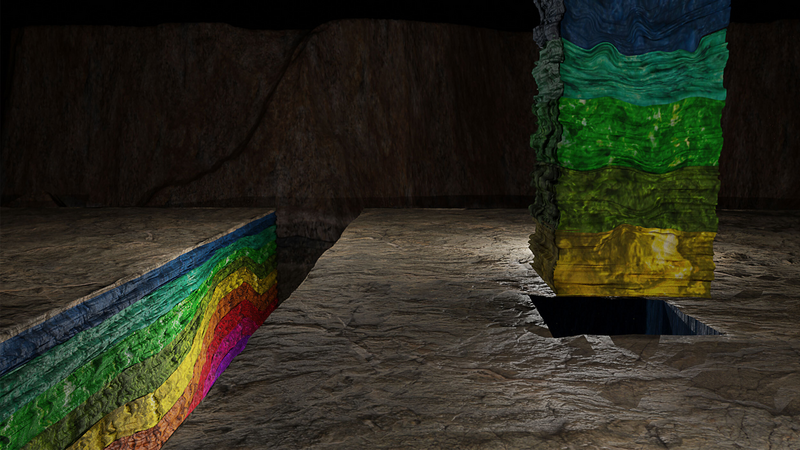
In addition, the company’s internal article included color photographs showing both 2D and 3D visualizations of the wellbore. In the 2D images, bedding and fracture types were “clearly differentiated.” In the 3D images, dip planes that had been “picked clearly” were displayed in different colors. As one of the operator’s Senior Geologists stated, “The InSite AFR sensor logs show numerous geological features in line with expectations.”
According to Sperry’s Ahmet Aki, rig costs in this area run approximately $50,000 per day. So the InSite AFR sensor saved the company about $150,000 on the first well alone. Since then, the new sensor has been used in two subsequent horizontal wells in the same field. “Each time, the sensor has saved around three days of rig time,” said Aki. At about $150,000 per well, the company has saved approximately a total of $450,000 from these three wells.
The InSite AFR sensor was also used in a fourth well. However, the operator ran a traditional wireline electrical imaging tool back to back with the LWD sensor, for comparison. “Not only did it take ten days to log the well with the other technology, due to tool failures,” Aki recalled, “but the company was happier with the InSite AFR sensor interpretation, as it was more advanced than our competitor’s.”
“Like other LWD sensors, the InSite AFR sensor acquires data prior to borehole deterioration and invasion,” Aki concluded. “However, it offers other real-time benefits including geological correlations for potential geosteering applications.”
Sperry’s Hossam Hassan explained: “While this new sensor does not restrict the BHA design, it is desirable to deploy a rotary steerable system to facilitate continuous rotation while delivering better hole quality and optimizing measurement integrit