Modeling application facilitates the development of custom pit management system for CCUS operation
Download PDFCCUS

Displace wellbore from oil-based mud to brine and clean casing of debris

North America

An operator aimed to complete a carbon capture, utilization, and storage (CCUS) appraisal well to conduct formation evaluation and assess the suitability of future wells for CO2 sequestration.
To accomplish the data acquisition, the operator created a protocol that required large volumes of completion brine to conduct a series of injection fall-off tests (IFT), step-rate test (SRT), and mini-frac test (MFT). These tests were designed to evaluate the reservoir and determine permeability, thickness (kh), breakdown pressures, reservoir quality, fracture gradient, and injection capacity of the target intervals. In addition, upon completion of the operations, the well was to be displaced with a suspension fluid to protect and preserve it until the next stage of development.
CCUS wells are relatively new to onshore operations in North America. Completing these wells presents several challenges, including:
In addition to the successful execution of the displacement and wellbore cleanout (WBCO), Halliburton was tasked with delivering a design of service that addressed the challenges associated with the build, filtration, treatment, and storage of approximately 20,000 bbl of completion brine. The solution also required coordination with third-party vendors to provide the operator with an integrated service that covered the full scope of the planned operations.
To support the customer's objectives, Halliburton developed a comprehensive fluids plan that addressed all operational and logistical challenges. The plan for the wellbore cleanout was developed using Completion Fluids Graphics (CFG™) software to optimize parameters of the displacement and wellbore cleanout, such as hydraulics, volumes, spacer formulations, contact time, physical separation, and flow rate requirements.
The fluids program provided a strategic solution to the logistical and volume management challenges at each stage of development. Halliburton collaborated with third parties to supply on-site mixing capabilities, a high-flow DE filtration unit, and scalable storage tanks. Once assembled, the customized pit system provided a working capacity of ~13,500 bbl of solids-free injection brine available to the pumping units through a central manifold.
bbl of solids-free brine built and filtered on location
ppg sodium chloride/potassium chloride treated
Total solids content filtered
Halliburton executed the fluids plan designed for the completion of the customer’s CCUS well. This plan resulted in a clean wellbore and the successful injection of more than 21,600 bbl of solids-free brine, all built and filtered on location. Halliburton delivered a customized completion fluids solution that integrated multiple vendor services into a streamlined operation. This approach improved efficiency, minimized waste and potential haul off, reduced transportation costs, and helped support formation evaluation of the target zones. The success of this integrated fluids strategy has led other operators to adopt and deploy it for the completion of their CCUS projects across North America.
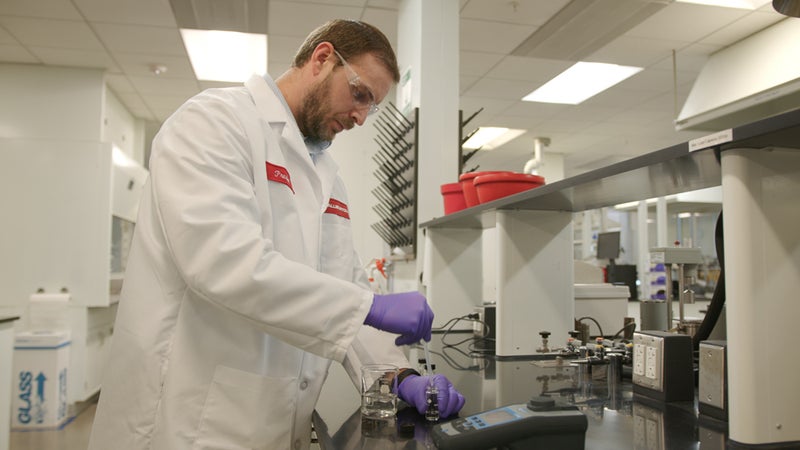
Halliburton completion fluids optimally prepare, repair, clean out, and complete the wellbore to maximize production.