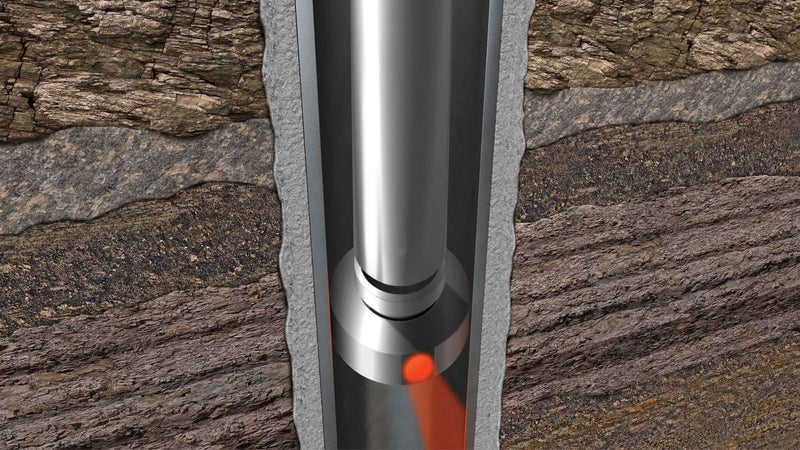
Forecast cement bond integrity before the operation and validate predictions with real-time or post-job pressure matching data
talk to an expertMake cement evaluation proactive with Halliburton’s cement log visualizer. It helps transform cement bond evaluation from a reactive process into a predictive workflow. The software incorporates actual job data for validation to help operators reduce risk, improve well integrity, and minimize unnecessary logging runs.
Engineers can input job parameters such as slurry design, pump schedule, casing setup, and well geometry. The tool simulates fluid placement, highlights potential contamination zones, and predicts cement bond integrity using factors like standoff, centralization, fluid properties, pumping schedule, wellbore geometry, and execution performance. Results are presented in an easy-to-interpret cement map, delivering adjustments before execution.
The cement log visualizer helps predict cement integrity before deciding whether logging is necessary by identifying contamination risks early and streamlining post-job evaluation. It supports planning efficiency by focusing logging efforts where risk is higher and provides dashboards that consolidate critical parameters for faster analysis.
The tool supports cost avoidance by reducing unnecessary cement bond log runs and their respective rig time, improves job design through upfront adjustments, and helps prioritize logging where it matters most. It also simplifies evaluation by presenting predicted and actual logs in a single view.
During and after the job, the visualizer refines predictions using real-time data such as pump rates, densities, and pressure responses. It displays predicted and actual cement logs side by side with the specific logging company's standardized color palettes, making interpretation straightforward. This comparison helps operators evaluate prediction accuracy and assess the ability of the predictive model to reduce and/or eliminate the need for running logging services and associated rig time.
| Parameter | Value |
|---|---|
| Prediction type | Cement map response with contamination analysis |
Data integration | Real-time pump rates, fluid properties (density, rheology), wellbore geometry, standoff, and pressure response |
Visualization | Side-by-side predicted and actual cement logs |
Dashboard parameters | Standoff, fluid concentrations, cement map, cement concentration prediction, dogleg severity, deviation, channel potential factor, and open hole size |
Documentation | Exportable for compliance and reporting |
Cement bond integrity is critical for wellbore security. Traditional evaluation methods often identify isolation issues several days after the job, which can lead to gas migration, sustained casing pressure, and costly remediation. The visualizer offers pre- and post-job insights using actual job data, helping teams make informed decisions and reduce operational uncertainty.